What is missing?

Maya Lin’s final memorial

July 5, 2012

“The project, called “What is Missing?,” seeks to highlight issues surrounding biodiversity and species loss due to human action and inaction through a variety of installations and media including sculptures like the Listening Cone at the California Academy of Sciences, over 150 videos such as “Unchopping a Tree,” and hundreds of stories collected through the What is Missing? Foundation’swebsite. Strongly focused on individual experiences of what Lin calls ‘the Sixth Great Extinction,’ the What is Missing? project seeks to educate world citizens about the dangers of habitat destruction and the former vitality and diversity of places around the globe.

The fact that the project straddles the disciplinary boundaries between architecture, landscape, sculpture, and information design makes it especially accessible and compelling, and raises the question of whether a memorial need be a static object, such as a statue on a pedestal. In fact, this memorial is constantly changing as visitors to the website submit memories of rivers that used to teem with fish but now run empty, or of forests where now only subdivisions run to the horizon.”

http://www.architizer.com/en_us/blog/dyn/44188/maya-lins-final-memorial/

Doorley and Witthoft: Make Space

Make Space hits the jackpot for our Space chapter. I just got my copy. It’s by the guys responsible for learning environments at the d.school at Stanford.

Make Space : How to Set the Stage for Creative Collaboration by Scott Doorley & Scott Witthoft is out!  Based on the work at the Stanford University d.school and its Environments Collaborative Initiative, it is a tool that for helping people intentionally manipulate space to ignite creativity.

Zvez’s notes while reading this book:

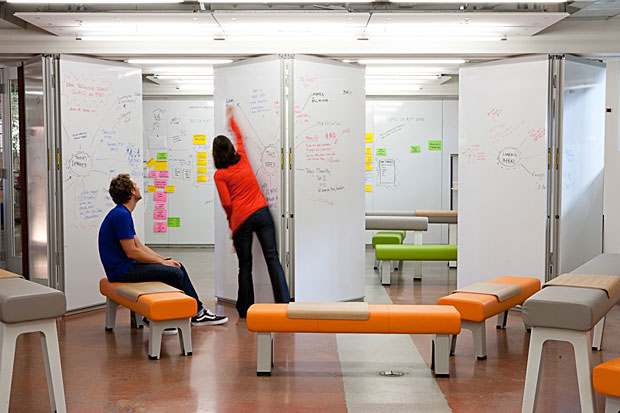
  • Includes great examples of flexible work furniture they’ve built over the years…everything is on wheels, portable or collapsable. Flexibility is key to interdisciplinary workspace. You, the teacher, need to be able to reconfigure the room easily each time you need to. Spatial arrangement influences how we think and what we do, and the outcomes we produce.
  • Designed by Open (Scott Stowell); Assumes a toolkit-like look. Brechtian in self-referential page titles. The white highlights on the orange pages are hard to read. Too many different-colored pages, sometimes really hard to read, for example black type over deep cyan bg. Can’t make heads or tails of the color palette.
  • Instead of the classic “table of contents,” they have “instructions” pages
  • Big fans of shower board or tile board as a dry erase surface. (26)
  • Space transmits culture. Context is content. (22)
  • The Periodic Table is a smart cheap square top table on wheels that is used as the basic furniture module in their classrooms (28)
  • Doing at least some of the physical construction makes you an “Invested owner rather than entitled user” (31)
  • “Space is the body language of an organization” Chris Flink, IDEO (38)
  • They have this notion of a “design template” as a method for working with space. Part of it is called “actions”, essentially the design process, composed of these stages: saturate, synthesize, focus, flare, realize and reflect. (47)
  • Discussion of the space design for the TED conference (54)
  • “Casters are revolutionary: they will change your space.” (60)
  • Throughout the book they encourage people to start small and build upon their initial efforts, rather than delaying doing anything because of lacks of funding or room.

d.school classroom design

11 Ways You Can Make Your Space as Collaborative as the Stanford d.school

BY LINDA TISCHLER | 05-06-2010 | 7:51 AM

on Fast Company

dschool

The Stanford d.school, which opens officially on May 7, is a space whose design has been refined over the course of six years to maximize the innovation process. Every wall, everynook, every connecting gizmo, every table, every storage cabinet, has been created with a grand, collaborative vision in mind.

Nice for them. But what about the rest of us, out here in standard-issue cubicle land? Are we all destined for subprime collaborative work lives because our office spaces and furniture are so numbingly left brain?

Not so, says George Kembel, the executive director of the school. Even if your company doesn’t have a few million to throw at making your space more innovation-friendly, there are things you can do to optimize what you’ve got. The d.school team sat down and brainstormed 11 great ways to transform your digs into a little hive of bubbling creativity–or at least a place that manages to capture the occasional good idea.
dschool bathroom1. Start with what you have. “We started in a trailer,” Kembel points out, “with the ‘d.school’ as a sign on the table.” Kembel’s advice: Claim a space and label it.

2. Go to the people who are interested first. Form a crack team of true believers to spearhead your campaign. Revolutions start from the bottom up.

3. Empower your team to change their space. Somebody high enough up the food chain needs to defend this activity against facilities managers who may not be amused. Then, be willing to keep changing things. Try out different ways to configure space to see what works best.

4. Watch the behavior of the group and take notes. Have somebody in your band of innovators own this task. What’s working, what isn’t? “Try, reflect, modify,” says Kembel.

5. Develop group-sized artifacts. Whaa? In short, forget the spreadsheets with the tiny type. “Get your ideas up in big enough form so that others can see and add to them.”

6. Keep any prototypes, sketches, or idea-jam artifacts low-rez and not precious. “Don’t get too formal too fast,” says Kembel. Making things precious locks them in too soon, short-circuiting potential improvements.

7. Show your work in progress. “Put your underwear up on the line and let people comment. But keep it safe,” Kembel says. No rude comments allowed.

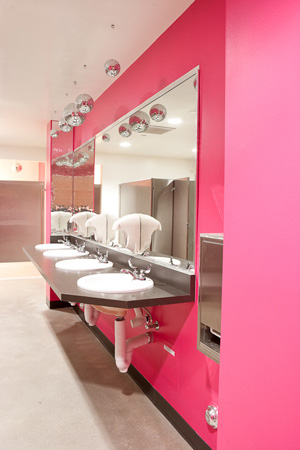
8. Do something simple to surprise people. At the d.school, they painted the women’s restroom lipstick pink, and hung disco balls. “That makes people realize that somebody cares about your experience,” Kembel says.

9. Invest more in “we” spaces than in “I” spaces. Cozy nooks for teams, not plush corner offices for the alpha dogs.

10. Mix up seating options. Take the table out of the room and sit on the floor. Vary seat heights. Change customary positions at meetings. For example, put the group leader in the middle, instead of at the head of the table. Try holding a meeting where only standing is allowed. In general, work to lower status markers.

11. Make idea generation and capture easy. Any non-porous surface can be a whiteboard, says Kembel. Buy a sheet of sheer acrylic at Home Depot and mount it on a wall as a writing space. Keep markers handy. Put prototyping tools out where people can grab them when an idea strikes.

“Creativity follows context,” says Kembel. The main idea, he says, is not to segregate creativity from other activities. “You don’t need to be fancy to do it,” he says.

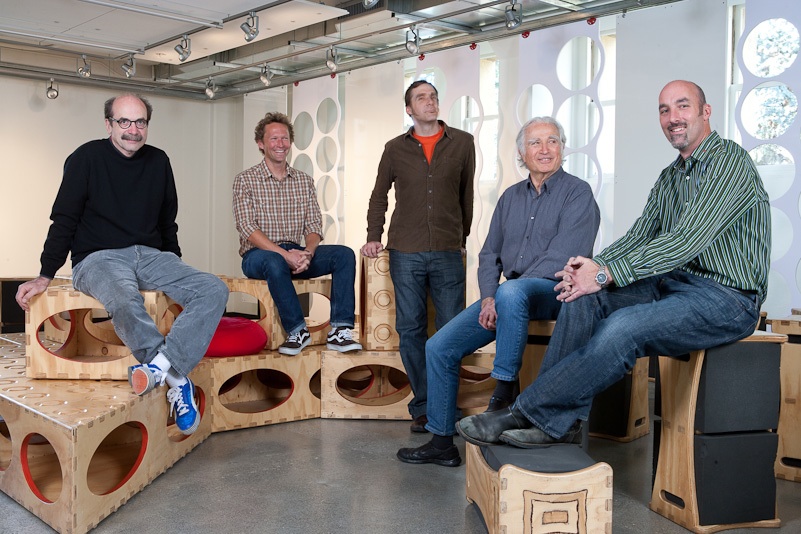
d.school principals (l to r): d.school founder David Kelley, Environments Collaborative co-directors Scott Witthoft and Scott Doorley, academic director Bernie Roth, and executive director George Kembel.

 

George Maciunas: Fluxus

A founder of Fluxus, the influential 60’s anti-elitist art movement, George Maciunas trained as a graphic designer, and often went back to that work to support his more radical artistic activities. His flux boxes were interdisciplinary object collections used (not so lucratively) for fundraising but also to spread the Fluxus word.

Seen above: Flux Year Box 2, c.1967, a Flux box edited and produced by George Maciunas, containing works by many early Fluxus artists. (from Wikipedia)

More from WIkipedia: Maciunas, a trained graphic designer, was responsible for the memorable packaging of fluxus objects, posters and newspapers, helping to give the movement a sense of unity that the artists themselves often denied.[19] He also designed a series of name cards incorporating multiple fonts to characterise each of the participating artists. According to Maciunas, Fluxus was epitomized by the work of George Brecht, particularly his word event, “Exit.” The artwork consists solely of a card on which is printed the words: “Word Event” and then the word “Exit” below.

Graphic Design and Startups

http://startupsthisishowdesignworks.com// 

Website devoted to the idea that graphic design plays a big role in startups.

Includes Dieter Rams’s “Good Design Is…” list.

Includes list of designers who are also startup owners:
__AirBnB, the rent-out-your-room startup that’s sweeping the nation, whose founder, Joe Gebbia, is a graphic designer.
RISD alum, double major in graphic and ID design. Airbnb is “the ebay of space”.

__Dave Morin, Path, a “smart journal that helps you share your life with the ones you love”
__Jack Dorsey, Twitter and Square, an app that turns your iPad or mobile device into a cash register that accepts credit card payments
__Mike Matas, Push Pop Press, a digital publisher that produced Our Choice,  the first full length interactive book, w/Al Gore, and now has been bought out by Facebook.
__Jeffrey Veen, Typekit, a subscription font service for the web
“Good artists copy, great artists steal” We should “stand on the shoulders of giants.” Typekit was acquired by Adobe in 2011.

Peter Buchanan Smith: Best Made

If a graphic designer makes an axe, is that graphic design? I think so.

This outdoors company was founded in 2010 (?) by NYC designer Peter Buchanan Smith. The started with axes and now makes a few other things. Very manly, very primal. But I think it’s interdisciplinary because here’s a graphic designer following his other passion (male outdoorsy stuff) and mixing it up.

http://www.bestmadeco.com/pages/our-story

Meredith Davis — Article

Article Title: Design’s Inherent Interdisciplinarity

Link to pdf: Davis_interdisciplinary

  • Design can increase problem solving and cognitive ability
  • High-skill jobs require “knowing how to learn,” a skill that traverses boundaries
  • Students need to communicate in verbal, visual and computational languages (1)
  • Attempts toward integration in grade schools are usually shallow and do not take “visual thinking” as a tool, but rather as a “gift” that cannot be taught. Usually, artistic “process” is equated with technique, not thought.
  • In such cases, collaboration is limited to subject matter, skill or vehicle for presentation, and excludes utilizing “visual thinking”.
  • Students who are discipline-schooled usually need to be “retrained” by their employers to consider multiple angles of the professional problem and become resourceful in an interdisciplinary kind of way.
  • The goal is to focus on cognitive skill, and not on fact-learning.

Why is design (so well suited to) interdisciplinary (study)?

  • Design problems are “situated”; they have clear contexts that can be used as springboards for research.
  • Design problems relate to the “real-world”. They’re not totally artificial.
  • Design problems are not just about the problem at hand. They are also about “ways of knowing”.
  • Design mockups are very close to the real thing, and can be easily tested.
  • Design is analytical and synthetical
  • Architect Christopher Alexander says: Design is the goodness of fit between form and context.
  • Design is systems-based; It needs to exist in a relationship of users and stakeholders. It doesn’t exist in a vacuum.
  • Design often requires interdisciplinary teams, and as such teaches us  about planning and collaborating and building a common vision.
  • Gives example of elementary students (Hawthorne Elementary) improving a piece of land by engaging all kinds of disciplines in a multi-year process. Interdisciplinary approach allows students to model real-world problem solving in a respectful and productive way.
  • Design experiences as tools for integration
  • Art teachers need to be educated about design more, while still in school. That way they can use it as a cross-disciplinary tool.

Build: Lego and Google collaboration

Infinite building possibilities from Lego and Google collaboration

http://www.itsnicethat.com/articles/build accessed 6/26/12 by Zvez
Posted by James Cartwright
Back in the good old days of yore children whiled away their afternoons in idol play, lost in their imaginations with nothing but bed sheets, twigs and a muddy pit at the back of the house as props for their elaborate role-playing. Kings waged wars, empires fell and everyone had to get cleaned up before tea. Then came Lego and the shape of play changed forever, so much so that those little coloured blocks and weekend afternoons will be linked in my mind forever.

Fast-forward a couple of decades and Lego’s gone digital, offering fans the opportunity to rebuild the world (well, Australia for the time being) in its own blocky image. Build, a collaborative project between Lego Australia and Google Chrome, fuses WebGL, the very latest in in-browser graphics, and Google Maps to allow users the chance to build, share and even renovate their very own digital Lego structures on a global platform. Complete structures can then be shown off to friends and family via email or Google+.

This may not be the tactile experience we’ve come to expect from Lego but their commitment to pursuing projects on digital platforms is impressive for a product so naturally grounded in the physical world. The online Build experience also encourages the more social aspects of Lego play that long-time fans hold dear. Best of all however is the staggeringly awesome possibility of INFINITE BLOCKS, a literal impossibility in the physical world.

Eat that bed sheets and sticks.