Albert France-Lanord Architects designed an amazing office space for Swedish ISP, Bahnohof. Located 30m underground and was a former atomic bomb shelter.
http://blog.eoffice.net/2010/08/bahnhofs-white-mountain-office/



Albert France-Lanord Architects designed an amazing office space for Swedish ISP, Bahnohof. Located 30m underground and was a former atomic bomb shelter.
http://blog.eoffice.net/2010/08/bahnhofs-white-mountain-office/
“You might have expected community-centered t-shirt company Threadless to have an interesting workspace, and you would be right. Above is the company’s Airstream trailer studio where Kristen Studard and Bob Nanna broadcast a live show on Ustream every Thursday from its Chicago headquarters.”
http://mashable.com/2010/09/20/inspiring-offices-pics/

“There is nothing like a big orange slide plonked right in the middle of an office to obliterate hierarchy between upper management and everyone else. But then Toronto creative agency Grip Limited, home to that big orange slide, has never been a place for hierarchy. Grip, whose clients include Acura, Lululemon Athletica and Labatt, has an unusually linear team, with an astounding 11 partners. David Crichton, one of eight founding partners calls it a “flat structure” in which partners work directly with clients, and therefore with their own designers, writers, interactive and technical staff who put together campaigns. “There’s no corner office mentality. There isn’t actually a corner office,” Crichton says, adding that newly hired president Harvey Carroll has the worst digs in the space – a small, drafty office that no one else wants.”
+ They notice the little things. White Astroturf lines one of the boardrooms. “It deadens sound,” Crichton says, “but it’s also not expensive. We like to do things creatively that don’t involve spending a lot of money. It sends a message to clients that you can be creative without being excessive.”
+ That working-class ethos turns up in Grip’s logo, a bright 1960s-style orange circle meant to show the company’s working-class roots. “I would say the culture here is pretty peer-oriented. Our partners work on a client’s file directly, so that means we worked directly with everyone here,” Crichton says. (Click to see a TV reel of some of Grip’s work.)
+ The non-linear structure of the company lets employees move between departments for rare wholesale career changes within the same company. For instance, a longtime studio manager became a designer and later an art director. One former IT staffer went on to become a multimedia editor/producer at Grip’s in-house production facility. The strategy is to “let people make a career change and then keep them in the company. At the end of the day, [the happiness of] a bigger paycheque only lasts two pay periods. If you provide a place where people like to work and are respected, they’ll be happier and more enthusiastic.”


“Wayne and Geraldine Hemingway, designers (they were the founders of Red or Dead) and judges of Enterprise Nation’s new Home Business Award, have a wonderful shedworking atmosphere, a teepee in their back garden known as Hemingway’s Outdoor Home Office (or HOHO). It has two levels with a suspended communal desk on the ground floor deck. The wood comes from sustainable sources including 10 BT telegraph poles. More details at their website hereand an article about it in Whatlaptop here which concentrates more on the technology they use to work from the teepee and where Hemingway says:”
“I love the outdoors, and to be in touch with the environment. So I have set up an outdoor workspace at home on the south coast, which has electricity fitted, as well as being a wireless networked space. I can take my laptop there to work, and can use scanners and printers if I need to, but still be in touch with the environment outside my home. There is a similar space at the London office – a garden with wireless networking, so we can work outside on nice days.”
Architect who does some amazing space transformations such as a cardboard office! http://coudamydesign.com/
1979, Architecte DPLG live and work in Paris
His work is not confined within a clearly defined aesthetics; it is a transversal approach of different disciplines that results in a polymorph type of practice. Different media are used without distinction: architecture, video, design, space design, clothing… It is a universe where productions are feeding each other and where the different media are possibilities to explore and question.
These productions are opportunities to reinvent everyday objects and relationships to their functions while suggesting poetic and disturbing diversions.


This from Good Magazine via Nancy:
http://www.good.is/post/winner-create-your-ideal-workspace-project/

For our latest challenge, we asked you to create your ideal workspaceshowing us what makes for optimal productivity. From graphic design artists to elementary school principals, our readers convinced us that the ideal workspace would be anywhere other than a conventional room. We received so many creative submissions that we couldn’t decide for ourselves, so we turned to our GOOD community to vote on the final winner.
Our winner is Logan Hendricks, whose workspace embedded on an oceanside cliff is a reminder that the ideal work environment is an area we spend most of our time but more importantly, a space which we should enjoy. Hendricks describes his ideal workspace this way:
My ideal workspace brings the outside in. The space is embedded in the side of a steep ocean cliff. Most of the space is within the cliff face, with the rest cantilevering out over the ocean. The bright sunny side of the space is for working on and assembling my ideas, while the cool shady side is for thinking and napping on my day bed. The bright side would have my computer and large work table, while the back would have a couch for reading and thinking and a day bed for napping. The walls of the space have all the odds and ends I need to keep me going, and keep me thinking: Rows of books, a stereo, coffee pot, my cello, etc. Fresh water pours from a spout in the back wall and runs through the space into the ocean below, pausing for a second in a small reflecting pool in the middle of the room. I could get a drink or wash up in the reflecting pool whenever I need to feel a little fresher. This would be my Shangri-la, my Perfect work space.
Logan will receive a GOOD t-shirt and a year’s subscription to the magazine. Thank you to the GOOD community for bringing your talent and creativity to our projects. Keep it up readers—you guys are great!
Liz Dwyer, Education Editor
Good (magazine)
August 30, 2011 • 5:30 am PDT

Schools aren’t businesses and shouldn’t be treated like they are, but a recent story at Fast Company Design has some pretty compelling suggestions about what they could learn from innovative private companies. The article focuses on the lessons of Google, IDEO, and Pixar, successful businesses known for using office design and corporate culture to maximize collaboration, creativity and playfulness. Those aren’t traits commonly associated with today’s classrooms, but perhaps they could be.
Imagine what learning could look like if more district administrators and education reformers adopted IDEO’s “culture centered on design thinking and interdisciplinary projects instead of siloed subjects”? Similarly, if Pixar’s culture of merging art and science together found its way to schools, students “might come to understand that the lines between music, math, physics, and art are much blurrier than textbooks make them appear.” And if Google’s emphasis on a playful and creative environment went mainstream in classrooms, we might not hear kids complaining that they’re bored.
That’s not to say the kind of ideas that rule Google, IDEO and Pixar are completely absent from schools. Places like High Tech High in San Diego, or Dubiski Career High School in Texas, are examples of what’s possible. Yet despite shining examples of other ways of doing things, the “school as a factory” model still dominates.
Most teachers, school administrators and other education reformers say that collaboration, creativity, and playfulness are desirable traits in schools, but for the most part, education reform isn’t going in that direction. The pressure of high-stakes standardized testing combined with budget cuts means that too often, school administrators aren’t thinking past rigorous math and reading curricula. Even kindergarten, which used to be the domain of learning through exploration and play, is increasingly taught in the same dry academic style that so often causes older students to check out of school.
Ironically, the article notes, executives at Google, IDEO and Pixar were probably inspired to buck the traditional stagnant, corporate culture by moving toward the more playful atmosphere that exists in schools when they’re at that best. We have to believe that schools can reclaim that spirit, and if it takes a little idea-borrowing from business to make it happen, so be it.
screenshot via YouTube user BIEBL
Make Space hits the jackpot for our Space chapter. I just got my copy. It’s by the guys responsible for learning environments at the d.school at Stanford.
Make Space : How to Set the Stage for Creative Collaboration by Scott Doorley & Scott Witthoft is out! Based on the work at the Stanford University d.school and its Environments Collaborative Initiative, it is a tool that for helping people intentionally manipulate space to ignite creativity.

Zvez’s notes while reading this book:
BY LINDA TISCHLER | 05-06-2010 | 7:51 AM
on Fast Company
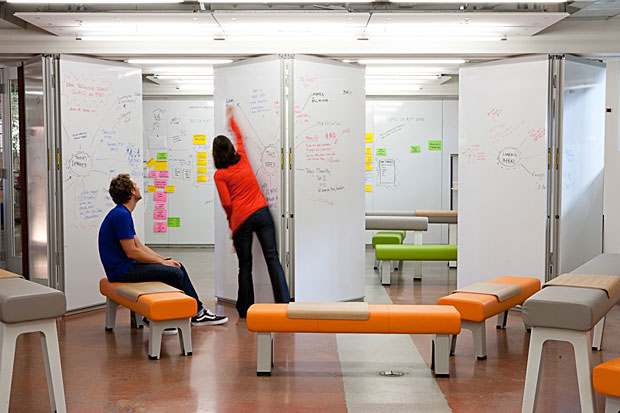
The Stanford d.school, which opens officially on May 7, is a space whose design has been refined over the course of six years to maximize the innovation process. Every wall, everynook, every connecting gizmo, every table, every storage cabinet, has been created with a grand, collaborative vision in mind.
Nice for them. But what about the rest of us, out here in standard-issue cubicle land? Are we all destined for subprime collaborative work lives because our office spaces and furniture are so numbingly left brain?
Not so, says George Kembel, the executive director of the school. Even if your company doesn’t have a few million to throw at making your space more innovation-friendly, there are things you can do to optimize what you’ve got. The d.school team sat down and brainstormed 11 great ways to transform your digs into a little hive of bubbling creativity–or at least a place that manages to capture the occasional good idea.
 1. Start with what you have. “We started in a trailer,” Kembel points out, “with the ‘d.school’ as a sign on the table.” Kembel’s advice: Claim a space and label it.
2. Go to the people who are interested first. Form a crack team of true believers to spearhead your campaign. Revolutions start from the bottom up.
3. Empower your team to change their space. Somebody high enough up the food chain needs to defend this activity against facilities managers who may not be amused. Then, be willing to keep changing things. Try out different ways to configure space to see what works best.
4. Watch the behavior of the group and take notes. Have somebody in your band of innovators own this task. What’s working, what isn’t? “Try, reflect, modify,” says Kembel.
5. Develop group-sized artifacts. Whaa? In short, forget the spreadsheets with the tiny type. “Get your ideas up in big enough form so that others can see and add to them.”
6. Keep any prototypes, sketches, or idea-jam artifacts low-rez and not precious. “Don’t get too formal too fast,” says Kembel. Making things precious locks them in too soon, short-circuiting potential improvements.
7. Show your work in progress. “Put your underwear up on the line and let people comment. But keep it safe,” Kembel says. No rude comments allowed.
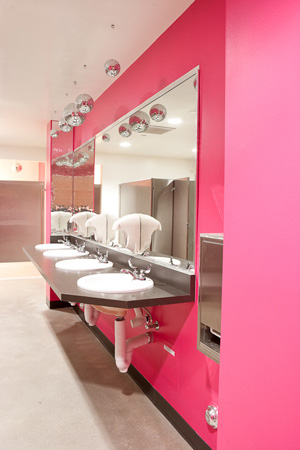
8. Do something simple to surprise people. At the d.school, they painted the women’s restroom lipstick pink, and hung disco balls. “That makes people realize that somebody cares about your experience,” Kembel says.
9. Invest more in “we” spaces than in “I” spaces. Cozy nooks for teams, not plush corner offices for the alpha dogs.
10. Mix up seating options. Take the table out of the room and sit on the floor. Vary seat heights. Change customary positions at meetings. For example, put the group leader in the middle, instead of at the head of the table. Try holding a meeting where only standing is allowed. In general, work to lower status markers.
11. Make idea generation and capture easy. Any non-porous surface can be a whiteboard, says Kembel. Buy a sheet of sheer acrylic at Home Depot and mount it on a wall as a writing space. Keep markers handy. Put prototyping tools out where people can grab them when an idea strikes.
“Creativity follows context,” says Kembel. The main idea, he says, is not to segregate creativity from other activities. “You don’t need to be fancy to do it,” he says.
d.school principals (l to r): d.school founder David Kelley, Environments Collaborative co-directors Scott Witthoft and Scott Doorley, academic director Bernie Roth, and executive director George Kembel.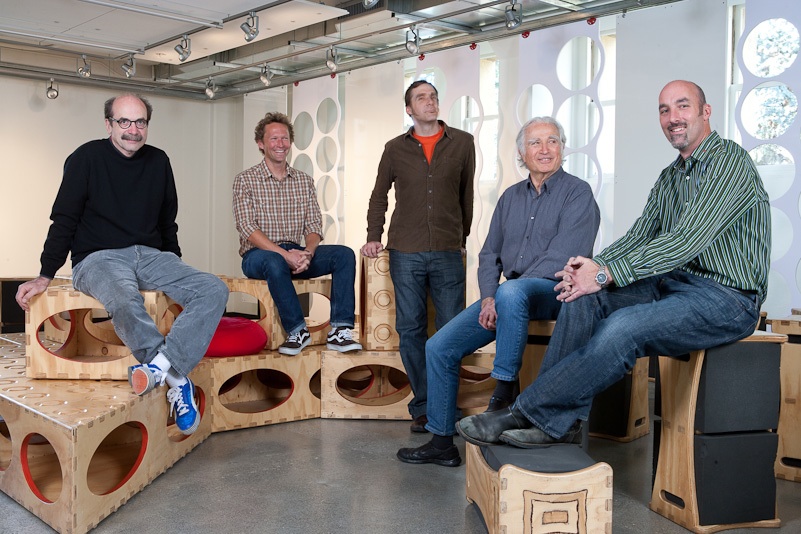
Wall-E: Reconfigurable Walls at Stanford d.school Make Each Class the Perfect Size, by Linda Tischler, 4/28/2010, on the Fast Company website
Fast Company article on the moveable walls of the new d.school building at Stanford. The innovative idea here is that the instructor can literally change the layout of the classroom making a “perfect fit” for each class.


“The school’s second floor is, essentially, one large room, framed by a truss system that lets planners design a series of sliders, attached with a gizmo they call a “taco” to a beam-mounted C-channel. That allows teams to create instant studios, of the exact dimensions appropriate to the day’s activities. Need a cozy nook? Done! A wide-open expanse of space? Not a problem.”
“The system allows a modal shift between intimate and open,” says Scott Witthoft, co-director with Scott Doorley of the school’s Environments Collaborative, which designed the arrangement along with Dave Shipmen of Steelcase.”

