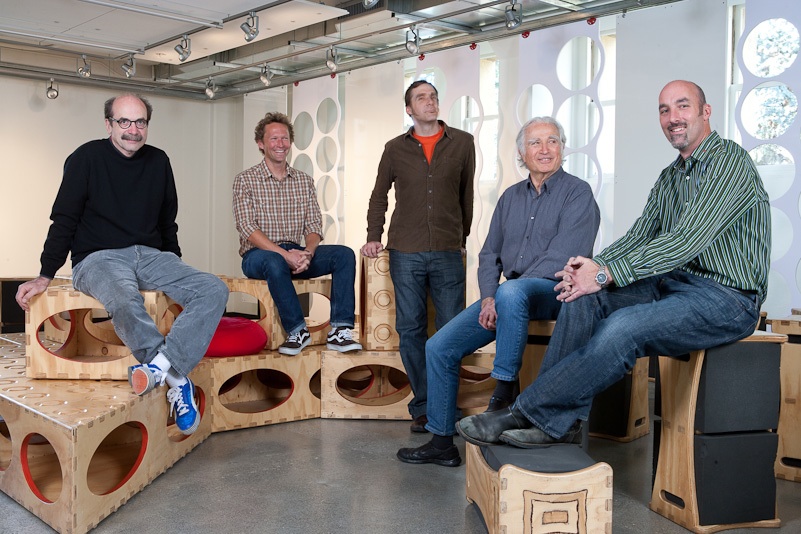
Make Space hits the jackpot for our Space chapter. I just got my copy. It’s by the guys responsible for learning environments at the d.school at Stanford.
Make Space : How to Set the Stage for Creative Collaboration by Scott Doorley & Scott Witthoft is out! Based on the work at the Stanford University d.school and its Environments Collaborative Initiative, it is a tool that for helping people intentionally manipulate space to ignite creativity.

Zvez’s notes while reading this book:
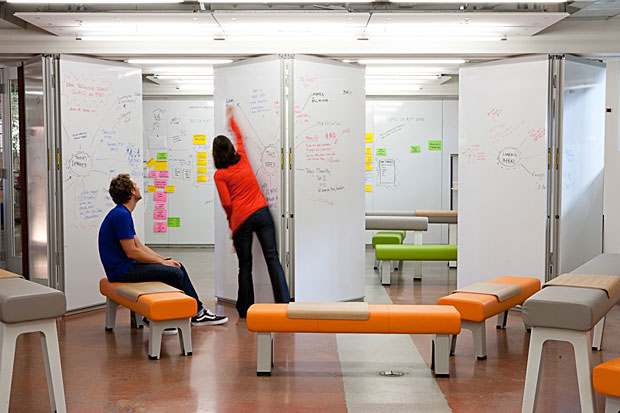
- Includes great examples of flexible work furniture they’ve built over the years…everything is on wheels, portable or collapsable. Flexibility is key to interdisciplinary workspace. You, the teacher, need to be able to reconfigure the room easily each time you need to. Spatial arrangement influences how we think and what we do, and the outcomes we produce.
- Designed by Open (Scott Stowell); Assumes a toolkit-like look. Brechtian in self-referential page titles. The white highlights on the orange pages are hard to read. Too many different-colored pages, sometimes really hard to read, for example black type over deep cyan bg. Can’t make heads or tails of the color palette.
- Instead of the classic “table of contents,” they have “instructions” pages
- Big fans of shower board or tile board as a dry erase surface. (26)
- Space transmits culture. Context is content. (22)
- The Periodic Table is a smart cheap square top table on wheels that is used as the basic furniture module in their classrooms (28)
- Doing at least some of the physical construction makes you an “Invested owner rather than entitled user” (31)
- “Space is the body language of an organization” Chris Flink, IDEO (38)
- They have this notion of a “design template” as a method for working with space. Part of it is called “actions”, essentially the design process, composed of these stages: saturate, synthesize, focus, flare, realize and reflect. (47)
- Discussion of the space design for the TED conference (54)
- “Casters are revolutionary: they will change your space.” (60)
- Throughout the book they encourage people to start small and build upon their initial efforts, rather than delaying doing anything because of lacks of funding or room.
 1. Start with what you have. “We started in a trailer,” Kembel points out, “with the ‘d.school’ as a sign on the table.” Kembel’s advice: Claim a space and label it.