Pixar

http://video.nytimes.com/video/2011/02/09/movies/1248069625002/a-rare-look-inside-pixar-studios.html 

A Nytimes video about the company…talks about Toy Story

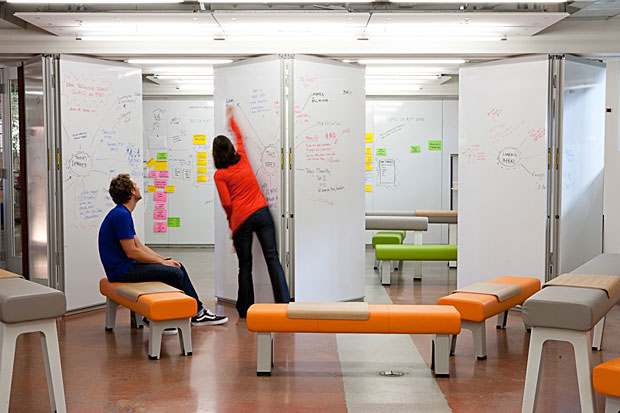
The design of the building (by Steve Jobs) purposefully forces collisions between employees from different departments.

There are fun tricks and hidden treasures in the building…like a secret speakeasy…and giant sofas…Talk about physical prototyping scale models to test their design before they animate everything…lots of hand-drawn and hand-built work goes into it.


Alissa Walker: The Design Difference…

The Design Difference: Using Design to Conduct a Problem-Solving Workshop
http://www.good.is/post/the-design-difference-using-design-to-conduct-a-problem-solving-workshop/ 

By Alissa Walker, Good magazine, January 21, 2011

GOOD was asked to attend The Design Difference, a charrette held by the Japan Society, Common Ground, and the Designers Accord. In this series, we’re examining design solutions to social problems and ways for designers to contribute pro bono work for the proposed solutions. Read the first post here.

Design is a process made for solving problems. Yet in the last few years, that process has come under fire when designers have attempted to solve problems that have little to do with their own experience. Last year, Bruce Nussbaum stoked a vicious debate when he wondered if designers working to solve problems in developing nations might be part of a new breed of imperialism. And it’s happening right here at home, too. In 2007, I covered Project M, a group of designers working to bring clean water to rural Alabama, where a third of the population lives in poverty. The program was successful in the sense that it raised money, yet the group of outsiders were criticized by angry local residents and, as New York Times article outlines, some efforts were not well-received by the community itself.

This idea of “parachuting in,” or the effectiveness of designers working outside of their own cultures, was part of what The Design Difference charrette hoped to examine. By concepting ideas for Brownsville, Brooklyn, one of New York’s most underserved communities, the group’s leaders also hoped to understand how using design as a tool for problem-solving had evolved.

“Designers used to rely on their methodologies and tools to create empathy, but as an industry, we’ve reached the limits of just imagining the situations of others,” says Valerie Casey, founder of the Designers Accord, who organized The Design Difference. “This charrette is part of an ongoing exploration into how we might get better at using our craft in more purposeful and relevant ways.”

To help, Casey enlisted John Peterson, founder of Public Architectureand The 1%, an initiative that asks design firms to donate one percent of their annual billings to pro bono projects. In Peterson’s experience of seeing hundreds of firms working for marginalized communities, the mistakes made from parachuting in are less about designing outside one’s cultural framework and more about not having the necessary team in place to do effective work. In Brownsville, our local connections were built-in. “We chose to work closely with an informed and deeply-embedded client,” says Peterson. “Greg Jackson and Common Ground were the conduits into the Brownsville culture, which was unfamiliar to the most of the design team.”

In addition to Jackson, the organizers were careful to bring together an extremely diverse group of designers and non-designers, ranging from residents of Brownsville who could offer the most personal accounts of what has worked in the past, to Japanese residents who might be able to bring an outside perspective from another culture. Five countries were represented, with live translation bridging any language barriers. “I think the two critical aspects of this charrette was that each participant had direct experience working with community of need, so there was a great sense of humility to balance the optimism,” says Casey. “In addition, each participant knew that this event was part of a longer journey and conversation.”

Human-Centered Design

After an immersion day spent in Brownsville, meeting residents and activists, the group gathered at the Japan Society’s headquarters in Manhattan for a full day. We were divided into small groups of about eight participants, and listened as Casey reviewed the insight we had gained through our conversations and observations the day before. I remembered the stories from Jackson and other residents about shootings and vandalism and began to feel a sense of despair. How could design honestly help with Brownsville’s larger, complex societal issues of poverty, violence, and drug use?

My reaction wasn’t unusual, says Casey. “When faced with the abstract and seemly intractable issues around sustainability, designers often ask for specific direction about what they can do,” she says. The goal for the charrette, she says, is to provide an entry point to a very real, basic needs where designers could contribute constructively.

Casey encouraged the group to step back from such specific problems and focus on two strengths of the design process: human-centered design, which caters to the needs of the user; and systemic thinking, which looks at solutions within a larger context. Both would prevent myopic investigation of data-driven facts like drugs and violence, and focus on the larger, people-driven conditions that could make Brownsville a better place to live. Therefore, we would focus on larger issues of improving food, health, and housing, rather than “stopping crime.”

Also crucial was the fact that not all solutions would be equally-weighted when it came to implementation—some would take longer than others. So Casey created a grid where the larger categories (food, housing, environment, transportation, health, retail,) were paired with various timelines (three weeks, three months, one year), and assigned to each group. So while one group was concepting solutions for improving health that could be implemented in three months, another group was thinking up ideas for housing solutions that could be implemented in three weeks.

The timeframes gave great guidance for narrowing lofty ideas into what would be possible to achieve. Each group was given about 30 minutes in which to tackle a specific combination, then we’d be asked to switch to another assigned category and timeframe. This prevented potential burnout from banging our heads against the same problem all day.

The format of the brainstorming, or ideation, exercises moved from an unedited, uncensored burst of ideas (divergent thinking), into more actionable, physically-oriented solutions (convergent thinking). Each group began the brainstorming period by layering a page with quick ideas—or pieces of ideas—jotted on Post-its. Over time, common themes or similar trains of thought were grouped together and built upon, and the best three to five ideas were drafted into more specific concepts.

Turning Ideas Into Action

This cascade of ideas, not a prescriptive mandate of what Brownsville must do, showed that the group was sensitive to the fact that there was not one single solution, says Peterson. “There was no conclusion, which would have been an unrealistic goal in my opinion,” he says. “The abundance of actionable solutions offered fresh insights to the people on the ground and didn’t try to suggest that there was a quick or simple solution.” To further clarify our thinking and turn those ideas into solid, action-based initiatives, we were asked to draw our concepts, or make a quick-and-dirty prototype of what this idea would look like out in the world. We were also asked to list the desired outcomes, and how those outcomes might be measured.

But perhaps the most important part of the charrette was a built-in dedication to follow through that might manage to transcend the pitfalls designers face when working in underserved communities and developing nations. Instead of creating a series of fanciful computerized renderings, or grand ideas that needed funding, we created simple but detailed, visually-based initiatives that built upon the work of our established contacts at Brownsville Partnership and Common Ground. “Our instant gratification culture, which is largely manufactured by design, was shifted in this charrette,” says Casey. “We were able to deeply understand the years of effort by the Brownsville Partnership, and could see how this charrette is part of a process, not its end point.”

In many ways, the charrette highlighted the way that designers have shifted from creating things to creating ideas, which Casey has also seen through the Designers Accord’s work. “Three years ago we focused on evolving our design practices by applying the principles of sustainability to the objects we were creating,” says Casey. “Now we are applying our craft to create the kind of content and change in a way that supersedes ‘design,’ and is utterly more connected with society at large.”

At the end of the day, we posted our concepts around the room, marveling at the range and diversity of ideas. Some of the same objectives had a dozen different ways to achieve them listed beneath. Some of the concepts were the same, but had completely different goals. Casey then went through and organized the concepts thematically, from transportation ideas to crowdsourcing projects. At the end of the day, the group had hundreds of ideas grouped into 27 concepts for Brownsville and five major themes. Each of the participants voted for their favorite ideas, which would then be consolidated and streamlined by Casey and Common Ground into actionable initiatives for Brownsville.

Thanks to Valerie Casey and the Japan Society, you can download the all the charrette tools here to organize your own problem-solving workshop: Here’s the Workshop Outline (PDF), the Brainstorming Map (PDF), and the Concept Worksheet (PDF).

In part three, we’ll see the concepts that were prototyped for Brownsville and give you more information about how you can lend your time and services to the initiatives.

Read all three stories in the series here.

Photos by Ayumi Sakamoto

Exercise: Workspace

This from Good Magazine via Nancy:
http://www.good.is/post/winner-create-your-ideal-workspace-project/ 

Winner: ‘Create Your Ideal Workspace’ Project
By Christine Wong, Community Coordinator Intern, December 16, 2011


For our latest challenge, we asked you to create your ideal workspaceshowing us what makes for optimal productivity. From graphic design artists to elementary school principals, our readers convinced us that the ideal workspace would be anywhere other than a conventional room. We received so many creative submissions that we couldn’t decide for ourselves, so we turned to our GOOD community to vote on the final winner.

Our winner is Logan Hendricks, whose workspace embedded on an oceanside cliff is a reminder that the ideal work environment is an area we spend most of our time but more importantly, a space which we should enjoy. Hendricks describes his ideal workspace this way:

My ideal workspace brings the outside in. The space is embedded in the side of a steep ocean cliff. Most of the space is within the cliff face, with the rest cantilevering out over the ocean. The bright sunny side of the space is for working on and assembling my ideas, while the cool shady side is for thinking and napping on my day bed. The bright side would have my computer and large work table, while the back would have a couch for reading and thinking and a day bed for napping. The walls of the space have all the odds and ends I need to keep me going, and keep me thinking: Rows of books, a stereo, coffee pot, my cello, etc. Fresh water pours from a spout in the back wall and runs through the space into the ocean below, pausing for a second in a small reflecting pool in the middle of the room. I could get a drink or wash up in the reflecting pool whenever I need to feel a little fresher. This would be my Shangri-la, my Perfect work space.

Logan will receive a GOOD t-shirt and a year’s subscription to the magazine. Thank you to the GOOD community for bringing your talent and creativity to our projects. Keep it up readers—you guys are great!


Article: What Schools Can Learn…

What Schools Can Learn From Pixar and Other Creative Companies

Liz Dwyer, Education Editor
Good (magazine)
August 30, 2011 • 5:30 am PDT


Schools aren’t businesses and shouldn’t be treated like they are, but a recent story at Fast Company Design has some pretty compelling suggestions about what they could learn from innovative private companies. The article focuses on the lessons of Google, IDEO, and Pixar, successful businesses known for using office design and corporate culture to maximize collaboration, creativity and playfulness. Those aren’t traits commonly associated with today’s classrooms, but perhaps they could be.

Imagine what learning could look like if more district administrators and education reformers adopted IDEO’s “culture centered on design thinking and interdisciplinary projects instead of siloed subjects”? Similarly, if Pixar’s culture of merging art and science together found its way to schools, students “might come to understand that the lines between music, math, physics, and art are much blurrier than textbooks make them appear.” And if Google’s emphasis on a playful and creative environment went mainstream in classrooms, we might not hear kids complaining that they’re bored.

That’s not to say the kind of ideas that rule Google, IDEO and Pixar are completely absent from schools. Places like High Tech High in San Diego, or Dubiski Career High School in Texas, are examples of what’s possible. Yet despite shining examples of other ways of doing things, the “school as a factory” model still dominates.

Most teachers, school administrators and other education reformers say that collaboration, creativity, and playfulness are desirable traits in schools, but for the most part, education reform isn’t going in that direction. The pressure of high-stakes standardized testing combined with budget cuts means that too often, school administrators aren’t thinking past rigorous math and reading curricula. Even kindergarten, which used to be the domain of learning through exploration and play, is increasingly taught in the same dry academic style that so often causes older students to check out of school.

Ironically, the article notes, executives at Google, IDEO and Pixar were probably inspired to buck the traditional stagnant, corporate culture by moving toward the more playful atmosphere that exists in schools when they’re at that best. We have to believe that schools can reclaim that spirit, and if it takes a little idea-borrowing from business to make it happen, so be it.

screenshot via YouTube user BIEBL


d.school classroom design

11 Ways You Can Make Your Space as Collaborative as the Stanford d.school

BY LINDA TISCHLER | 05-06-2010 | 7:51 AM

on Fast Company

dschool

The Stanford d.school, which opens officially on May 7, is a space whose design has been refined over the course of six years to maximize the innovation process. Every wall, everynook, every connecting gizmo, every table, every storage cabinet, has been created with a grand, collaborative vision in mind.

Nice for them. But what about the rest of us, out here in standard-issue cubicle land? Are we all destined for subprime collaborative work lives because our office spaces and furniture are so numbingly left brain?

Not so, says George Kembel, the executive director of the school. Even if your company doesn’t have a few million to throw at making your space more innovation-friendly, there are things you can do to optimize what you’ve got. The d.school team sat down and brainstormed 11 great ways to transform your digs into a little hive of bubbling creativity–or at least a place that manages to capture the occasional good idea.

dschool bathroom1. Start with what you have. “We started in a trailer,” Kembel points out, “with the ‘d.school’ as a sign on the table.” Kembel’s advice: Claim a space and label it.
2. Go to the people who are interested first. Form a crack team of true believers to spearhead your campaign. Revolutions start from the bottom up.

3. Empower your team to change their space. Somebody high enough up the food chain needs to defend this activity against facilities managers who may not be amused. Then, be willing to keep changing things. Try out different ways to configure space to see what works best.

4. Watch the behavior of the group and take notes. Have somebody in your band of innovators own this task. What’s working, what isn’t? “Try, reflect, modify,” says Kembel.

5. Develop group-sized artifacts. Whaa? In short, forget the spreadsheets with the tiny type. “Get your ideas up in big enough form so that others can see and add to them.”

6. Keep any prototypes, sketches, or idea-jam artifacts low-rez and not precious. “Don’t get too formal too fast,” says Kembel. Making things precious locks them in too soon, short-circuiting potential improvements.

7. Show your work in progress. “Put your underwear up on the line and let people comment. But keep it safe,” Kembel says. No rude comments allowed.

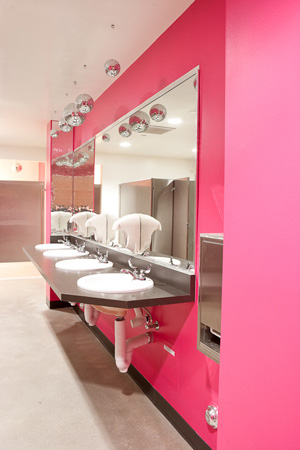
8. Do something simple to surprise people. At the d.school, they painted the women’s restroom lipstick pink, and hung disco balls. “That makes people realize that somebody cares about your experience,” Kembel says.

9. Invest more in “we” spaces than in “I” spaces. Cozy nooks for teams, not plush corner offices for the alpha dogs.

10. Mix up seating options. Take the table out of the room and sit on the floor. Vary seat heights. Change customary positions at meetings. For example, put the group leader in the middle, instead of at the head of the table. Try holding a meeting where only standing is allowed. In general, work to lower status markers.

11. Make idea generation and capture easy. Any non-porous surface can be a whiteboard, says Kembel. Buy a sheet of sheer acrylic at Home Depot and mount it on a wall as a writing space. Keep markers handy. Put prototyping tools out where people can grab them when an idea strikes.

“Creativity follows context,” says Kembel. The main idea, he says, is not to segregate creativity from other activities. “You don’t need to be fancy to do it,” he says.

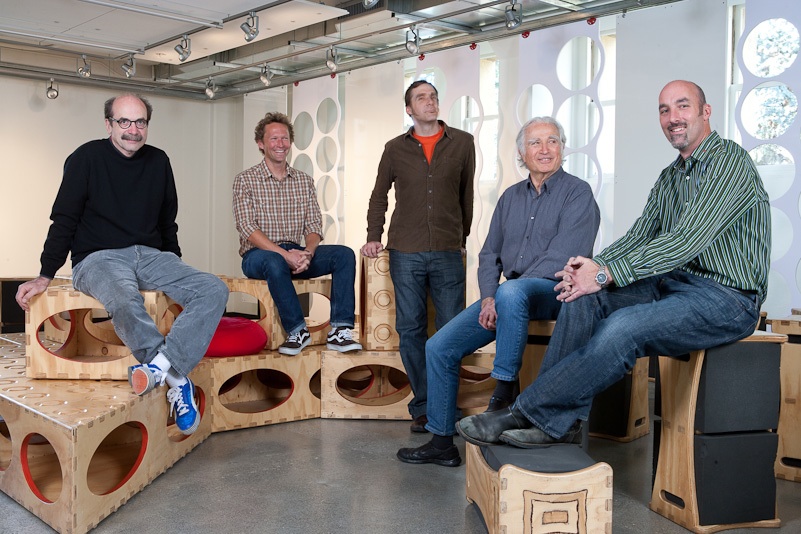
d.school principals (l to r): d.school founder David Kelley, Environments Collaborative co-directors Scott Witthoft and Scott Doorley, academic director Bernie Roth, and executive director George Kembel.


George Maciunas: Fluxus

A founder of Fluxus, the influential 60’s anti-elitist art movement, George Maciunas trained as a graphic designer, and often went back to that work to support his more radical artistic activities. His flux boxes were interdisciplinary object collections used (not so lucratively) for fundraising but also to spread the Fluxus word.

Seen above: Flux Year Box 2, c.1967, a Flux box edited and produced by George Maciunas, containing works by many early Fluxus artists. (from Wikipedia)

More from WIkipedia: Maciunas, a trained graphic designer, was responsible for the memorable packaging of fluxus objects, posters and newspapers, helping to give the movement a sense of unity that the artists themselves often denied.[19] He also designed a series of name cards incorporating multiple fonts to characterise each of the participating artists. According to Maciunas, Fluxus was epitomized by the work of George Brecht, particularly his word event, “Exit.” The artwork consists solely of a card on which is printed the words: “Word Event” and then the word “Exit” below.

Peter Buchanan Smith: Best Made

If a graphic designer makes an axe, is that graphic design? I think so.

This outdoors company was founded in 2010 (?) by NYC designer Peter Buchanan Smith. The started with axes and now makes a few other things. Very manly, very primal. But I think it’s interdisciplinary because here’s a graphic designer following his other passion (male outdoorsy stuff) and mixing it up.

http://www.bestmadeco.com/pages/our-story

Build: Lego and Google collaboration

Infinite building possibilities from Lego and Google collaboration

http://www.itsnicethat.com/articles/build accessed 6/26/12 by Zvez
Posted by James Cartwright
Back in the good old days of yore children whiled away their afternoons in idol play, lost in their imaginations with nothing but bed sheets, twigs and a muddy pit at the back of the house as props for their elaborate role-playing. Kings waged wars, empires fell and everyone had to get cleaned up before tea. Then came Lego and the shape of play changed forever, so much so that those little coloured blocks and weekend afternoons will be linked in my mind forever.

Fast-forward a couple of decades and Lego’s gone digital, offering fans the opportunity to rebuild the world (well, Australia for the time being) in its own blocky image. Build, a collaborative project between Lego Australia and Google Chrome, fuses WebGL, the very latest in in-browser graphics, and Google Maps to allow users the chance to build, share and even renovate their very own digital Lego structures on a global platform. Complete structures can then be shown off to friends and family via email or Google+.

This may not be the tactile experience we’ve come to expect from Lego but their commitment to pursuing projects on digital platforms is impressive for a product so naturally grounded in the physical world. The online Build experience also encourages the more social aspects of Lego play that long-time fans hold dear. Best of all however is the staggeringly awesome possibility of INFINITE BLOCKS, a literal impossibility in the physical world.

Eat that bed sheets and sticks.