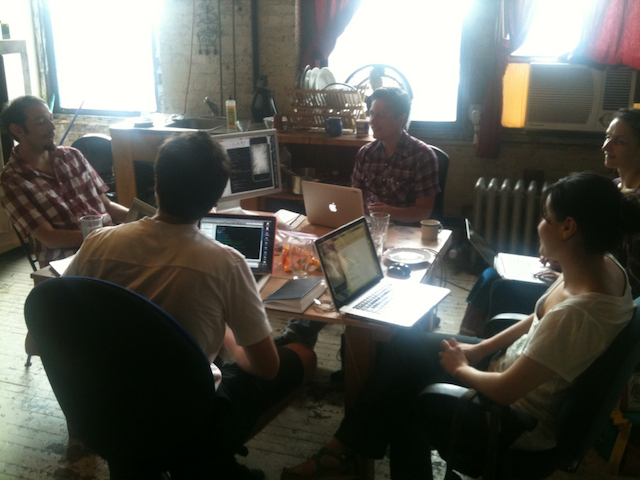
Creative workspaces

On this blog of design studio Eighty One, I found an assortment of creative office interiors.

http://www.eightyonedesign.co.uk/how-would-you-improve-your-graphic-design-studio-or-office/
Accessed 6/12/12

Google offices:
Office as set design, as adventure

Top left: Google office in Zurich, Switzerland, designed by Camenzind Evolution, Ltd.

Lego offices
Cartoon Network offices:
A bit of childhood nostalgia in your cubicle
Selas Cano, Spanish architecture office:
Melding with nature

Print Magazine Collaboration Issue

Print Magazine issue 65, 1 February 2011

Special issue on collaboration, guest edited and designed by Project Projects.
Project Projects is a NYC Design studio working with mostly cultural clients and doing a lot of publishing as well.

On page 34, Michael Rock of 2×4 says there are essentially three types of collaboration: “Prosthetic: Partnering to fill a lack (as in a writer and art director team up in an agency); Systematic: partnering to tackle extremely complex problems (as in architecture and film); and  Distributive: partnering, often asynchronously, to take advantage of global distribution (as in outsourcing).”

Fluxus, the 60’s art movement, focused on inter-disciplinary efforts. Cofounded by Dick Higgins and Alison Knowles. Fluxus artists sought to disrupt the traditional role of the artist as isolated creator with collaborations between writers, composers, artists and designers.


Kitchen Table Coders

Here’s another example of conversations. These guys get together every week in their Brooklyn loft to learn coding. Trouble is, there are 5 of them, and yet they limit attendance to 6 — which means one person can attend?! Weird. They should absolutely do these as webinars, so that a passive public can participate.

http://kitchentablecoders.com/2012/02/25/001-LISP/
From their website:
Table:Every week we host a workshop on a topic we’re passionate about.
We keep it down to 5 people because that’s how many fit around our kitchen table.
There’s no projector. We just hang out for the day, and enjoy a collaborative learning experience.
Chefs: Hi, we’re David, Amit & Ted. We both design software for a living and share a studio.
We’re ever curious about new and old languages, as well as the people who shaped them.
Sometimes we teach graduate courses, so we figured why not do informal workshops at our studio with like-minded folk.

Eric Ku: chair/chair

From “Now in Production” at the Walker Art Center.
from the Walker blog:
http://blogs.walkerart.org/design/2011/10/26/gdnip-3-konstantin-grcic-eric-ku-chair-design/ 

Eric Ku’s Chair/Chair.

In the Gallery…

Ku’s Chair/Chair in the typography section of the exhibition.

From the gallery label… Eric Ku’s Chair is made from pieces that when taken apart, spell out the word “chair.” Ku was inspired by a famous work by conceptual artist Joseph Kosuth, One and Three Chairs(1965). Kosuth placed a real chair in the gallery next to a photograph of the same chair (photographed in that gallery) and a definition from a dictionary.

Joseph Kosuth, One and Three Chairs (1965).

Design Convos at Dcenter Baltimore

glad to be of help! (all text credit goes to fred).

On Wed, Mar 21, 2012 at 3:53 PM, Sarah Doherty <sdoherty@mica.edu> wrote:

hello zvezdana-
glad of your interest in the d center design convos! they have been really wonderful!

i passed your questions on to some of my fellow board members, especially fred scharmen who is one of the principal coordinators of the events. see his responses below which echo my own thoughts as well.

let me know if you need or want more info and or responses!

best-

sarah

———- Forwarded message ———-

From: Fred Scharmen <sevensixfive@gmail.com>

Date: Tue, Mar 20, 2012 at 12:12 PM

Subject: Re: design convo’s – book publication

To: Sarah Doherty <sdoherty@mica.edu>

Cc: Klaus Philipsen <kphilipsen@archplan.com>, Brian Oster <boster@cbhassociates.com>, Ben Stone <ben.stone@gmail.com>, Marian <marian.glebes@gmail.com>

I can take a pass at answering some of these questions.

What would you say has been the main purpose of Design Convos?

When we started them, we weren’t really sure what the main purpose would turn out to be, other than to provide a venue for presenting and thinking about design work in the city (with both “design work” and “the city” defined in the broadest possible sense here). The thing that’s kind of become the main purpose is this – it’s been a very effective way to link up people and work that might otherwise not have gotten linked up. People might come in thinking that what they do is not relevant to a design context, or they think that others in different contexts won’t be able to relate to it, and they leave with hopefully a broader perspective and some new potential friends and collaborators.

In what way have they helped interdisciplinary efforts? 

These Conversations have put artists in the same room with developers, teachers in the same room with activists, politicians in the same room with architects, engineers together with community organizers … the list could go on and on. In the best cases, each discipline is able to absorb a little bit of what the constraints and opportunities are in other disciplines, from the point of view of the people inside them, and hopefully, each discipline is able to recognize that there are a lot of interesting resonances and productive differences in the spaces between what they do.

And could you name two or three concrete things that came out of them? For example, an exhibition, project, etc.

Sure, there’s Gary Kachadourian’s Baltimore Infill Survey: http://www.flickr.com/photos/baltimoreinfillsurvey/ , that came out of a Conversation on Vacancy that Gary hosted. There were a few articles written about it, and it got entries from all over the world via flickr. I think Sarah Doherty’s Access Alley project got a new level of interdisciplinary interest when it was presented at an early Design Convo, too.( http://www.axisalley.wordpress.com )  Eric Leshinsky’s notion of ‘cultural containers’ which was the subject of a convo he hosted, has helped focus some of my own thoughts as a spatial practitioner, I’ve expanded his thoughts in a few published articles. We’ve helped push the visibility of people doing interesting work in Baltimore, in everything from street art to bio-remediation, and after showing their work in our venue, they’ve gone on to do even bigger and greater things – kind of the ‘cultural container’ principle at work.

What we’ve been most of proud of, though, is this ability to make introductions and connections between people and practices. Many collaborations have been realized after people have exchanged email addresses during design conversations, with projects realized at festivals like Artscape and Transmodern, even architectural commissions growing from meetings here. These are harder to quantify, but in some ways even more ‘concrete’ than anything. My favorite story about a concrete outcome is the fact that I met my girlfriend Marian, also a cofounder of Dcenter and a Design Convo co-conspirator, at an early Design Conversation. ;D
 

everyone should go to art school

Thomas Kovachevich is both a physician and an artist. He’s practicing both his professions in NYC and has a show there right now.
http://www.nytimes.com/2012/03/23/arts/design/thomas-kovachevich-alpenglow.html?ref=arts
Here’s a video clip where he says that “everyone should go to arts school first, to learn how to solve problems, and then go and study whatever their chosen profession is.” Take a listen! (yay, I finally learned how to post videos, thanks nance)

method chapter: messages

  1. Make conversation (victore, d:center, etsy, social media)
  2. Ask “what if?” questions (byrom)
  3. Oppose yourself: do something opposite your norm (electroland)
  4. Apply a new method (type fluid and arkiypo, dearmond)
  5. Clarify your vision (bjork)
  6. Make yourself understood. Speak clearly, use simple language (bjork, ideo)
  7. Funny is good (bjork)
  8. Master gd basics (mm paris)
  9. Cultivate respect (mm paris)
  10. Apply graphics to unusual places (scarves, furniture) (mm paris, mike perry, joshua davis)
  11. Observe and listen (active listener) (ideo, froehlich, poggio)
  12. Build empathy (ideo, froehlich)
  13. Immerse yourself (froehlich, poggio)
  14. Question everything (project masilueke)
  15. Customize your process (project masilueke)

IDEO: Ely Lilly lab posters for scientists

Here’s a great example of a graphics driven IDEO project! Project Date: 2009

http://www.ideo.com/work/laboratory-posters/
From the website:

Inspiring scientists to be more patient-sensitive

Lilly is in the midst of an organization-wide transformation to become more patient-centered.
As part of this effort, the pharmaceutical company wanted to encourage its R&D scientists,who develop molecules and formulate therapies, to consider patient needs earlier in the drug development process. Lilly asked IDEO to design a series of inspirational posters for display in laboratories and hallways.

Together, Lilly and IDEO set out to create a series of posters for display in the labs and public areas of the formulation group that would address three needs:

    • Visually Arresting: The team wanted something attention-getting enough to catch the eye of heads-down scientists, compelling enough to remain on display for an extended period of time, and coherent as a system.
    • Provocative: Once a scientist moved in for a closer look, the team wanted the posters to be able to quickly educate them and inspire them, challenging their assumptions about the patients and how they experience the condition and therapy.
    • Informative: Beyond use in the hallways, the team wanted the posters to be useful in brainstorming exercises, with enough substance and explicit challenges to help the researchers connect the empathy to the reality of formulating new therapies.

Rather than use marketing messages or scientific language, they used the words of patients and their caregivers…to help scientists relate better to patients…great example of interdisciplinary effort…learning to talk like someone else in order to solve a problem.
Privacy restraints prevented them from using straight up patient shots, but they rather addressed challenges (and staged the photography, I assume)

Reaction from scientists withing the PR&D group: positive…used as inspiration throughout the company…bringing human-centered value to product development.

Project date: 2009