Creative workspaces

On this blog of design studio Eighty One, I found an assortment of creative office interiors.

http://www.eightyonedesign.co.uk/how-would-you-improve-your-graphic-design-studio-or-office/
Accessed 6/12/12

Google offices:
Office as set design, as adventure

Top left: Google office in Zurich, Switzerland, designed by Camenzind Evolution, Ltd.

Lego offices
Cartoon Network offices:
A bit of childhood nostalgia in your cubicle
Selas Cano, Spanish architecture office:
Melding with nature

5 examples of books that relate to our proposal

1. DESIGN IS
http://www.papress.com/html/book.details.page.tpl?isbn=9781568983141
Design Is celebrates the immense variety of design. Everyone and everything is here. Scholars, pundits, designers, architects, critics, and reporters are all represented, while everthing from election ballots to urban design, chairs to fuzzy logic, housing to the Internet is discussed. The richness of thought and stimulating ideas found here could only come from Metropolismagazine. Where else would bar codes be discussed along with cities, NASA rub shoulders with garden design, and a mechanical yam-pounder share space with Robert Moses? No other publication can provide the density of observation, range of perception, and unbridled enthusiasm for design found here. Like Metropolis itself, Design Is radiates the confidence and missionary zeal of those who would change the world

2. DOT DOT DOT
http://www.chroniclebooks.com/titles/art-design/graphic-design/dot-dot-dot-18.html
After seventeen issues, Dot Dot Dot remains the must-read journal on every designers desk. By steering clear of both commercial portfolio presentations and impenetrable academic theory, it has become the premier venue for creative journalism on diverse subjectsmusic, art, literature, and architecturethat affect the way we think about and make design. Dot Dot Dot 18 presents the latest fieldwork of a multidisciplinary group ofcontributors investigating the web of influences shaping contemporary culture. Smart, passionate, and imaginativelydesigned, Dot Dot Dot is for graphic designers and anyone interested in the visual arts.

3. TYPOHOLIC
http://www.victionary.com/book/typoholic_info.html
Letters and words are the most efficient way to talk. The great demand for quick and effective communication has challenged designers’ originality to innovate expressions in words, phrases and letter forms. From digital types to real life installations, Typoholic is a thorough review of modern type-making that makes the core of communication itself. In two separate sections, the book introduces more than 40 new illustrative and animated type families that come in a narrative package of alphabets, numbers and punctuations, followed by 200 colourful pages of ad-hoc projects featuring custom type designs as logo marks, campaign installations and editorial art. The book would particularly highlight how meanings of words and phrases multiples when typography meets design, handworks, photography, performance art and illustrations that individually convert the process of reading into unique experience which one can embrace, encounter, touch and explore.

4. DESIGN PLAY
http://www.victionary.com/book/design-play_info.html
Games and tricks often breed big ideas, and the idea of ‘Play’ has prompted artists and designers to bring peculiarity into the routine and amuse the bored with visual tricks and interactive designs. Be it simple or complicated, deliberate or unintentional, this art of spreading joy demands a strong commitment to break the rules and a knack of poking fun in a lighthearted way. From mimicries to interactive approaches that engage users in the development of desirable design outcomes, Design•Play put together a rich source of playful ideas that challenge your normative perceptions by means of five distinctive kinds of ‘Play’ embraced in graphic, product and spatial designs.

5. CREATIVE ISLAND
http://www.laurenceking.com/product/Creative+Island+2.htm
Following the success of the first volume, Creative Island 2 takes an entirely fresh look at the extraordinary range and quality of design in Britain today, including work from 25 design disciplines – from architecture and engineering to fashion and jewellery; from new media and graphics to theatre and retail design, and many more. Showing more than 100 recent projects, and also featuring design ideas and visuals of work that is yet to be realized, each one tells the designers’ stories of their work in their own words. Through a series of themes, John Sorrell explores the relationships between different projects and the way in which different disciplines cross-fertilize, which, he argues, is the key reason for the current wealth of inspired design from the United Kingdom.
Print Magazine Collaboration Issue

Print Magazine issue 65, 1 February 2011

Special issue on collaboration, guest edited and designed by Project Projects.
Project Projects is a NYC Design studio working with mostly cultural clients and doing a lot of publishing as well.

On page 34, Michael Rock of 2×4 says there are essentially three types of collaboration: “Prosthetic: Partnering to fill a lack (as in a writer and art director team up in an agency); Systematic: partnering to tackle extremely complex problems (as in architecture and film); and  Distributive: partnering, often asynchronously, to take advantage of global distribution (as in outsourcing).”

Fluxus, the 60’s art movement, focused on inter-disciplinary efforts. Cofounded by Dick Higgins and Alison Knowles. Fluxus artists sought to disrupt the traditional role of the artist as isolated creator with collaborations between writers, composers, artists and designers.


Kitchen Table Coders

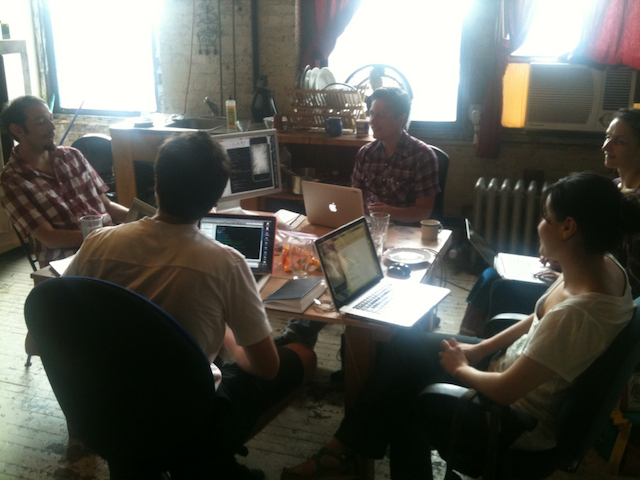
Here’s another example of conversations. These guys get together every week in their Brooklyn loft to learn coding. Trouble is, there are 5 of them, and yet they limit attendance to 6 — which means one person can attend?! Weird. They should absolutely do these as webinars, so that a passive public can participate.

http://kitchentablecoders.com/2012/02/25/001-LISP/
From their website:
Table:Every week we host a workshop on a topic we’re passionate about.
We keep it down to 5 people because that’s how many fit around our kitchen table.
There’s no projector. We just hang out for the day, and enjoy a collaborative learning experience.
Chefs: Hi, we’re David, Amit & Ted. We both design software for a living and share a studio.
We’re ever curious about new and old languages, as well as the people who shaped them.
Sometimes we teach graduate courses, so we figured why not do informal workshops at our studio with like-minded folk.

Para Clock

concrete, tradition, geometry, participatory

We love to make things, and we really want to make beautiful wall clocks.

Para-Clocks is about:

  • Combining digital design methods with traditional craft using concrete
  • And most importantly, involving YOU in the design process!

Inspiration

We were first inspired by radial geometry and symmetry found in architecture and textiles from every culture around the world. Certain patterns from these cultures can be boiled down to a simple set of steps and rules for making them. Designing using parametric software allows us to create many variations of radial patterns based off of similar sets of rules; but these are then played with and manipulated, allowing each pattern to be expressive in surprising ways.

watch the kickstarter campaign at: http://www.kickstarter.com/projects/224392735/para-clocks-project

poster, chair?

http://www.designboom.com/weblog/cat/10/view/19771/sebastian-errazuriz-occupy-chairs-the-armory-show-2012.html

sebastian errazuriz has developed the art-furniture collection ‘occupy chairs’. the series consists of twelve chairs formed from plywood, decorated by white acrylic paint and a replica of one of several signs used by protesters in the occupy wall street movement,
written in black paint upon the surface of the flattened folding chairs. the artist created the pieces as dual protest sign/seating implements.

when not in use, the message of the protester may be read on the surface of the object and while secured in chair form, the piece may serve protesters to better occupy public spaces. additionally, the series was created with the chilean-born artist’s vision to occupy the homes of the 1% with the message of the 99%. errazuriz believes this effort will be achieved through the action of the collectors, being typically of the 1%, purchasing a piece from the collection. this choice to purchase this art work would bring the sentiments of the protesters into the homesof the 1%. in this way, the art buyers would monetarily support the efforts of the masses and, by default, would share the message of the protesters with other members of this socioeconomic class.

as a double-sided mirror the occupy chairs also explore the potential for these complaints against the richest one percent to be transformed into
glamorous fashionable catch phrases in design-art pieces that celebrate the exclusive luxury market.
‘ – sebastian errazuriz

ruslan khasanov: making of sunbeam type

another example we could use in the last chapter. Follow the link to see them in motion.

http://www.designboom.com/weblog/cat/10/view/20136/ruslan-khasanov-making-of-sunbeam-type.html

khasanov, based in ekaterinburg, russia,
has developed an entirely sunlight-formed typeface, shaped through the dispersion of light. this phenomenon is most commonly observed in the occurrence
of a rainbow, displaying the spatial separation of white light into the differing wavelengths– resulting in a notable variation in color.

in order to harness this light effect, khasanov first experimented with glass and mirrors as he added water to these reflective media in an effort to create
the glittered, rainbow alphabet. in the initial ‘sunbeamtype’ explorations, the designer achieved interesting effects, although he realized he had not quite tapped into
the potential for what he had envisioned as a radiant, sunbeam typeface. khasanov tells designboom, ‘I thought of the light dispersion phenomenon (the splitting of the
white light into a rainbow). all I needed was to deflect the light by transparent refracting mediums. I’ve used gel by dabbing on a glass and then I draw
the letters on with a clean brush. all I had to do was to bring that glass to the sunbeam and to reflect letters by a lens on the background.’ 
by re-determining
the angle and a distance from which the digital camera was positioned to the piece of glass with gel-scrawled type, the designer was able to achieve a fascinating
trick of light. it was due to this subtle shift in materials and method that the designer was able to document his sun-formed font.